
Electrolysis Hair Removal Under General Anesthesia
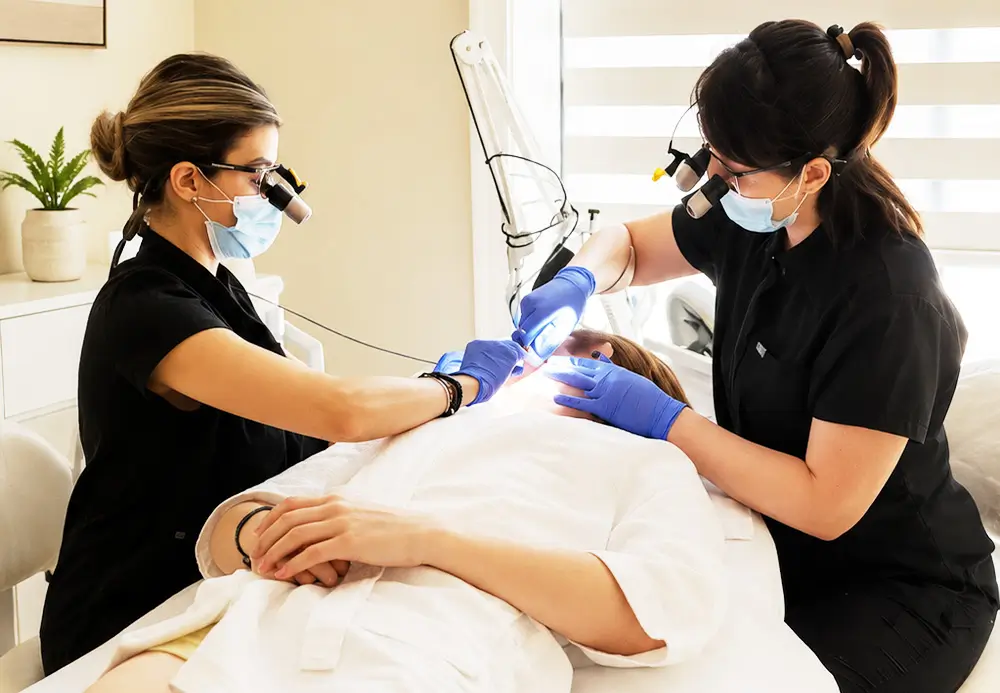
Electrolysis hair removal under general anesthesia means you are unconscious for the entire treatment day while a team of electrologists clears hair follicle by follicle. You go under, the work happens, and you wake up with an area finished that would otherwise have taken you months of weekly appointments to sit through awake.
This is a comfort option, not a different kind of electrolysis. The technique in the chair is the same one used on an awake client: a fine probe slides down the follicle, current destroys the growth cells, and the hair is lifted out. What changes is that you are not present for any of it, and that two or three electrologists can work on you at once without pausing for numbing injections.
It is a real option now at a small number of clinics across the United States, ours among them. It is also not for everyone, and the rest of this page is an honest account of who it suits, what it costs in time and money, what the risks are, and when one of the cheaper comfort levels makes more sense. If you are here because of surgery-date pressure, start with our transgender electrolysis page, which covers the four comfort levels side by side.
How a treatment day under general anesthesia actually runs
The day starts weeks earlier, at a consultation. We look at your hair color, density and the areas you want cleared, ask what hair removal you have already had, and ask for your surgeon’s diagram if you have a surgery date. Consultations can be done by phone or video, which matters because most of our anesthesia clients fly in.
If you are considering anesthesia or sedation, medical screening and anesthesia clearance come next. This is a gate, not a formality. Nothing gets booked until the anesthesia professional has reviewed your history and agreed you are a suitable candidate.
On the day itself:
- You arrive having followed fasting instructions given to you in advance.
- Anesthesia is started with inhaled anesthetic through a mask. Under our protocol there is no IV induction, which is the single thing that makes this workable for people with needle phobia.
- Once you are under, the electrologists begin. No local numbing injections are given, because you cannot feel anything.
- Two or three electrologists work at once on different areas, so the face and a body or surgical area can be covered in the same visit.
- The anesthesia professional stays in the room for the whole session, monitoring breathing and oxygen and adjusting as needed.
- You wake up in supervised recovery. A responsible adult takes you home.
The number that matters when you compare quotes is combined electrologist-hours, which is the total work done by everyone in the room. A day billed as 21 combined hours means three electrologists working roughly seven hours each. It is not 21 hours of anesthesia. Clinics that quote only a flat day rate are usually quoting one pair of hands, and that is a very different amount of hair.
Our long treatment session page goes into how these extended days are structured and why they clear more per hour than short weekly appointments.
Why people choose to be asleep for electrolysis
Electrolysis has a reputation for hurting and we are not going to pretend otherwise. Numbing cream and lidocaine take most of it away, and plenty of clients finish an entire plan awake. The people who ask about general anesthesia usually fall into one of a few groups.
The first is volume. If your first clearing is estimated at 21 or 30 combined hours, that is an enormous amount of time in a chair. Being asleep turns a year of dread into a handful of days you do not remember.
The second is a surgery date. Most surgeons will not operate on a vaginoplasty, phalloplasty or metoidioplasty site until it is cleared to their diagram, and the clearing has to be finished well before the date. People who find this out late often have a hard deadline and not enough calendar. Large-volume days under anesthesia are the fastest legitimate way to compress that work.
The third is needles. Awake and twilight protocols both rely on repeated lidocaine injections, and for some people that is the part that is genuinely impossible. Mask induction with no IV removes needles from the planned protocol entirely.
The fourth is simply that someone tried it once, sat through one session, and could not face booking a second. That is a common story and it is not a character flaw. The usual options were built around short appointments and low volume.
Genital and pre-surgical work deserves its own mention. It is slow, precise, and in an area most people would rather not be awake for. We give it a dedicated single-electrologist day, and you can see how that area is quoted on our genital area pricing page.
Who this was built for
- Transgender and gender diverse clients facing a large amount of clearing
- Anyone preparing for vaginoplasty, phalloplasty or metoidioplasty
- Clients with PCOS or hirsutism, or simply heavy facial and body hair
- Anyone dealing with paradoxical hypertrichosis after laser or other light-based hair removal
- People with severe anxiety, needle phobia or a very low pain threshold
- Anyone who would rather have a few highly productive treatment days than a standing weekly appointment
None of that makes you a difficult patient. It describes people the standard short-appointment model was never designed around.
General anesthesia is not the same as sedation
These words get used loosely in hair removal marketing, and the difference has real consequences for what your day feels like. The American Society of Anesthesiologists sets out the distinctions clearly in its patient guide to types of anesthesia, and it is worth reading before you book anything anywhere.
Under general anesthesia you are unconscious. You have no awareness and no sensation, and you remember nothing of the session. Because you feel nothing, local numbing is not used for comfort at all.
Under IV twilight sedation you are deeply relaxed and may drift in and out, but sedation does not numb skin. Lidocaine injections still have to be given, and in a long day they have to be given again. If needles are the specific thing you cannot face, twilight sedation does not solve your problem.
Oral conscious sedation keeps you awake and able to talk while feeling calm. It needs the full local protocol underneath it: numbing cream, lidocaine and nitrous oxide.
Awake with local comfort means prescription numbing cream, lidocaine dosed by weight, and patient-controlled nitrous oxide you breathe when you want it. Nitrous clears within minutes, so this is the only level where you can drive yourself home.
What being unconscious takes out of the treatment day
Comparing comfort levels only on how much they hurt misses most of the difference. The more useful question is what each level adds to the day, and what it removes. Under general anesthesia the planned protocol involves:
- No IV for anesthesia induction, because anesthesia is started with inhaled anesthetic through a mask
- No local numbing injections for electrolysis comfort, since there is nothing to numb
- No injection-related swelling, bruising or tenderness to recover from afterwards
- No repeated injections interrupting the work each time an earlier dose wears off
- No hours of bracing yourself and watching the clock
Long electrolysis sessions conventionally rely on topical anesthetic plus repeated lidocaine injections to keep sensitive areas tolerable. Those injections take time to administer, they fade over the course of a long day, and they leave swelling and bruising of their own. Removing them puts that time back into clearing hair, which is the entire reason for booking a long day.
The practical effect is compounding. Fewer interruptions means more follicles cleared per hour, which means fewer visits overall, which matters most to the people traveling for treatment or working against a surgery date.
The practitioner who sedates you should stay with you throughout
This deserves more attention than it usually receives. Our anesthesia and sedation providers remain at the clinic for the full treatment session, monitoring your breathing, oxygen and comfort from induction through to discharge, and adjusting or re-dosing whenever it is medically appropriate. You are never left in a room with only the electrologists.
Put that question to any clinic you are comparing, at any comfort level. Some practices administer sedation and then hand the room over. The answer tells you a good deal about how seriously a practice takes the medical side of what it is offering, and you are entitled to ask it before you pay a deposit.
One detail worth asking about at any clinic you compare. Some large-volume providers give a single dose of IV sedation at the start, mainly to help you tolerate the first round of injections. Its effect fades over the day, so by hour five you may be awake for the next set of injections. Ask whether re-dosing is planned, or whether the whole day is built around one starting dose. Our full breakdown of each option is on the electrolysis pain management page.
Safety, screening and the risks nobody should skip over
General anesthesia for a cosmetic or preparatory procedure is a serious medical decision, and it carries the same risks it carries anywhere else. Common short-term effects include nausea, grogginess, sore throat and confusion on waking. Serious complications are uncommon in healthy patients but they exist, and they scale with age, weight, airway anatomy and underlying heart or lung disease.
This is why clearance comes before booking rather than on the morning. Screening looks at your medical history, current medications including hormone therapy, allergies, previous reactions to anesthesia, airway anatomy, and whether you have a condition such as sleep apnea that changes the risk picture. Anesthesia providers use the ASA physical status classification to summarize this, and a higher classification does not automatically rule you out, but it does change the conversation.
Some people will be told no, or told to choose a lighter level. That is the screening working.
The requirements are not negotiable. You will need to fast beforehand, you will need a supervised recovery period, and you will need a responsible adult to take you home. Driving yourself is not an option at this level, and no reputable provider will let you.
Who it is generally not suitable for includes anyone with uncontrolled cardiac or respiratory disease, certain airway problems, and some people whose medication list creates interaction risk. That assessment belongs to the anesthesia professional, not to an electrologist and not to a website.
One honest counterpoint. If your total clearing is modest, or your skin is sensitive in a way that limits how long any single session can run, anesthesia may be an expensive solution to a problem that numbing cream already solves. Ask to be talked out of it before you commit. Our clinical team is listed on our team page if you want to know who you would be dealing with.
General anesthesia is available only to medically eligible patients and is administered and monitored by qualified anesthesia professionals, who retain responsibility for all anesthesia-related decisions and may change a planned anesthetic when patient safety requires it. Nothing on this page is medical advice.
How many sessions it takes, and how far ahead to start
One day under anesthesia does not finish you. Electrolysis only kills a follicle that is in its active growth phase, and at any moment a large share of your hair is dormant. That is why everyone needs repeat clearings no matter which comfort level they choose. How electrolysis works covers the mechanism in more detail.
What anesthesia changes is the shape of the schedule. Instead of an hour a week for a year, you grow the hair out once, come in for a full clearing, and come back when the dormant hair surfaces. Regrowth drops from one clearing to the next, so later visits are shorter days rather than full ones.
As a rough guide from our own scheduling:
| First clearing estimate | Typical visits | Approximate total hours |
|---|---|---|
| 14 to 15 combined hours | 3 to 4 | 35 to 37 |
| 21 combined hours | 5 to 6 | around 70 |
| 30 combined hours | 5 to 6 | around 100 |
These are estimates, and they move with hair density and color, the area treated, hormone levels, and how much laser you have had before. Someone with heavy paradoxical regrowth after laser will need more than someone starting fresh.
If you have a surgery date, work backwards from it and leave margin. Surgeons generally want the site cleared and settled before they operate, and you want room for one more visit than you think you need. Bring the diagram to your consultation and we will build the calendar around the date rather than around our availability.
What it costs and whether insurance pays
There is no honest flat price for this, and any clinic quoting one without seeing your hair is guessing. The cost of a day depends on how much hair there is, where it is, how many electrologists are working, how long the day runs, and which comfort level you choose. Anesthesia is a separate cost from the electrolysis itself.
We quote every plan individually in writing before you commit, covering combined hours, the number of visits, the comfort level and the full cost. Standard hourly rates for awake work are on our pricing pages, which is a reasonable place to calibrate expectations even if your plan ends up structured differently.
To get a useful estimate, tell us the areas you want treated, your hair color and density, any laser you have already had, your surgery date and surgeon if you have them, which comfort level you are leaning toward, and whether you are traveling in.
On insurance: pre-surgical hair removal for gender-affirming surgery is covered by a growing number of plans in the United States. Coverage depends on your plan, your state, your diagnosis codes and whether your surgeon documents the hair removal as a required step. General anesthesia is a separate line item and is the part least likely to be covered, since insurers often treat the comfort level as elective even when the electrolysis itself is approved. We walk through what we have seen work on our page about insurance coverage for electrolysis.
Ask your insurer for pre-authorization in writing. Verbal assurances from a call center have a way of evaporating at claim time.
Asleep electrolysis compared with the alternatives
| General anesthesia | IV twilight sedation | Awake with local comfort | Laser | |
|---|---|---|---|---|
| Conscious during treatment | No | Varies with depth | Yes | Yes |
| How it is given | Inhaled through a mask | Medication through an IV | Cream, injections, nitrous | No sedation |
| Needles in the planned protocol | None | Yes | Only if you choose lidocaine | None |
| Injection swelling or bruising | None | Possible | Possible | None |
| Hours clearable per day | Highest | High | Moderate | Fast per pass |
| Works on gray, blonde and red hair | Yes | Yes | Yes | No |
| Ride home required | Yes, plus supervised recovery | Yes | No | No |
| Regulatory status | Permanent hair removal | Permanent hair removal | Permanent hair removal | Permanent hair reduction |
The last row is the one people miss. Electrolysis is the only method the FDA recognizes for permanent hair removal. Laser is cleared for permanent hair reduction, which is a different claim. Laser targets pigment, so it thins a dark beard quickly and cannot see light, gray or fine hair at all. Those are exactly the hairs a surgeon will reject a site for.
That does not make laser useless. For someone with dense dark hair and a distant surgery date, a few laser sessions first can cut the volume substantially and shorten the electrolysis that follows. It is a sequencing decision, and it only works if you have the time. We cover the tradeoff in electrolysis vs laser hair removal and, for trans clients specifically, in our guide to combining laser and electrolysis.
One caution. Laser can trigger paradoxical hypertrichosis, where treated areas grow more hair rather than less. It is uncommon but it happens, most often on the face and neck, and it is one of the reasons some people end up needing a large-volume electrolysis plan in the first place.
Getting ready, and what the days afterwards look like
Before the session, grow the hair out. Electrolysis needs enough length for the probe to follow the follicle, so stop tweezing, waxing and threading in the treatment area well ahead of time. Shaving is fine and does not affect the root. The specifics for your area are on our pre-treatment instructions, and the day-of guide covers what to wear, what to bring and when to stop eating.
Arrange the ride home before you book, not the night before. Anesthesia days end with a supervised recovery period and a named adult collecting you.
Afterwards, expect redness, swelling and small scabs in the treated area. Because no local injections are used under general anesthesia, you avoid injection bruising and the puffiness that comes with it, but the electrolysis itself still leaves the skin irritated. Most people are comfortable being seen in public again within a few days, though this varies a lot with skin type and how much was cleared.
Keep the area clean, leave scabs alone, skip makeup for the first day or two, and stay out of strong sun. Our aftercare instructions are specific about products and timing, and following them is the main thing that separates a clean heal from a pigmented one, particularly on deeper skin tones.
If you are flying in, do not book a return flight for the same evening. Most of our out-of-town clients stay at least one night nearby. We keep a list of hotels close to the clinic on our accommodations page.
Common questions
Can you really get electrolysis under general anesthesia?
Yes, at clinics set up for it with a qualified anesthesia professional on site. It is uncommon, because most electrolysis practices are small studios without the staffing or clearance process this requires.
Does it hurt afterwards?
The treated skin is sore and red for a few days. You do not feel the session itself. Skipping the lidocaine injections removes the injection soreness that awake and twilight clients deal with.
How long can one session last?
Our formats run up to about 7.5 hours of work per electrologist, with two or three working at once, and up to two consecutive days for traveling clients. The exact length is set by the anesthesia professional based on your screening.
Is it safe?
General anesthesia is safe for most healthy adults when it is given and monitored by qualified professionals, and it still carries real risk. Screening before booking exists to decide whether that risk is acceptable in your case.
Will one session remove all my hair?
No. Hair grows in cycles and only actively growing follicles can be destroyed, so everyone needs several clearings regardless of comfort level.
Does it work on gray, blonde or red hair?
Yes. Electrolysis destroys the follicle directly and does not rely on pigment, which is why it finishes work laser cannot.
Can I have my face and genital area done in the same visit?
Yes, when the plan is built that way, since separate electrologists can work on separate areas. Genital and pre-surgical clearing is usually scheduled as its own single-electrologist day.
Do I need a consultation first?
Yes, and it can be done by phone or video if you are out of state. Video is more useful because we can see your hair on camera.
How far in advance of surgery should I start?
Earlier than you think. Bring your surgeon’s diagram and date to the consultation and we will count backwards. More questions are answered on our electrolysis FAQ, and facial rates are listed on the facial electrolysis pricing page.
Talk to us before you commit to anything
If you want to know whether electrolysis hair removal under general anesthesia is the right call for your hair, your health and your timeline, the next step is a consultation, not a deposit. Tell us your areas, your hair, your surgery date if you have one, and whether you would be traveling to us. We will send back a written estimate covering combined hours, visits and full cost. You can reach us through our contact page or by phone at (252) 722-5006, and our electrolysis Chicago home page covers everything else we treat.
Have a question about your own hair removal plan? A consultation is the fastest way to a straight answer.