A clean, sanitized room
Every surface and instrument is cleaned and disinfected between clients. You will never be treated in a room that has not been turned over since the person before you.

Your Treatment · Downtown Chicago
From numbing cream at home to the walk back out the door.
Most of the nerves people bring to a first appointment come from not knowing what actually happens once the door closes. So here is the whole thing: how to prepare, what your electrologist will do, how to make the session easier on yourself, and what your skin will look like for the next day or two.
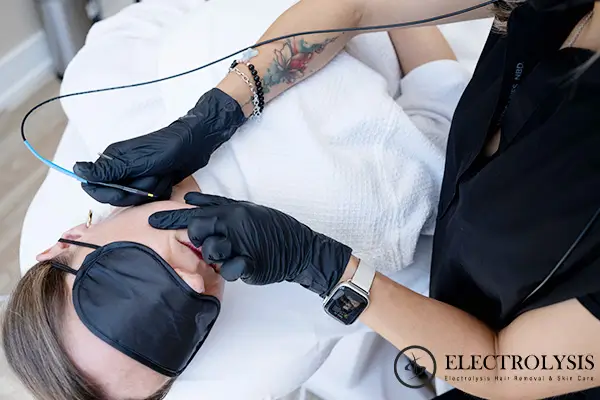
A treatment day goes better when nothing about it is a surprise.
Electrolysis is precise work. Your electrologist is treating one follicle at a time, which means the quality of your session depends partly on things that happen before you arrive: whether you numbed correctly, how rested you are, how comfortable you can get in the chair.
Everything below is what we tell clients in person. Read it once before your first appointment and you will know exactly what the day looks like.
Before You Arrive
Numbing cream is optional. When people tell us it did not work, the problem is almost always the timing or the wrap rather than the product itself. Follow the sequence below and it will do its job.
Wash the treatment area and dry it completely before you apply anything. Moisture, lotion or makeup left on the surface sits between the agent and the follicle and keeps it from absorbing.
Cover the cream with Glad Press’n Seal or plastic wrap and tape the edges down. Air deactivates the numbing agent, so a loose cover leaves you with very little effect by the time you sit down.
Add another coat over the first and re-seal it. One application rarely reaches full strength on its own.
Start two hours out and keep reapplying every half hour right up to your appointment time. That repetition is what carries the agent down to the base of the follicle, which is where the work happens and where you need the numbing to reach.
Numbing cream is the lightest of seven comfort options. If you are treating a sensitive area or booking a long session, there are stronger choices available, up to sleeping through the appointment entirely.
See All OptionsIn the Treatment Room
The standards below apply to every appointment we run, whether you are in the chair for fifteen minutes or most of a day.
Every surface and instrument is cleaned and disinfected between clients. You will never be treated in a room that has not been turned over since the person before you.
Your probe is opened in front of you at the start of the appointment and selected for your hair type, your skin, your health conditions and your pain threshold.
It is discarded when the session ends. Probes are never cleaned and reused.
Depending on the area and how elastic your skin is, your electrologist may ask you to help hold the skin taut. You may also be repositioned a few times so the area is easier to reach.
Both are normal, and both make the work more accurate.
During Your Session
You have more influence over how a session feels than most people expect. These four things make the biggest difference.
Take the time to settle in properly. Adjusting halfway through interrupts the work and costs you minutes you are paying for.
Talk to your electrologist, listen to something, or meditate. Where your attention goes has a real effect on how much you feel, and clients who stay distracted consistently report easier sessions.
The most effective treatment happens near the upper end of what you can comfortably tolerate. Tolerance also builds with repetition, so later appointments tend to feel easier than your first one did.
A high pain threshold makes it tempting to book long stretches on one spot. We still recommend capping any single treatment area at fifteen-minute increments. Your skin recovers better for it.
After Your Treatment
The most common description clients give is a mild sunburn. Some reaction is expected, and it is a sign the follicles were treated.
Your electrologist applies witch hazel and aloe vera at the end of the session. We may also perform cataphoresis, an aftercare procedure that soothes the skin, reduces swelling and gets healing underway sooner.
Expect the treated area to look inflamed or red. How long it lasts depends on your skin and the length of the session, and it typically settles anywhere from a couple of hours to two days afterward.
We will walk you through your home-care routine before you go. The two things that matter most are keeping the skin clean and keeping it well hydrated.

Ready When You Are
To be fair to all clients and to use our time effectively, we have established the following cancellation guidelines: for appointments that are one hour or less, we require at least 24 hours notice. For appointments longer than one hour, a minimum of 72 hours notice is necessary. For treatments scheduled for four hours or more, we require at least 14 days notice. If proper notice is not given, a fee of 100% of the scheduled service will be charged. If you need to make changes to your appointment, please call us at (252) 722-5006 or email us at [email protected].
Keep Reading
If you’ve never had electrolysis or laser hair removal at our location, we require a consultation before scheduling your first appointment.
For out-of-state clients, consultations can be conducted online.
Request Online Consultation ⟶