
Laser First, Then Electrolysis: How We Combine Both for Transgender Hair Removal
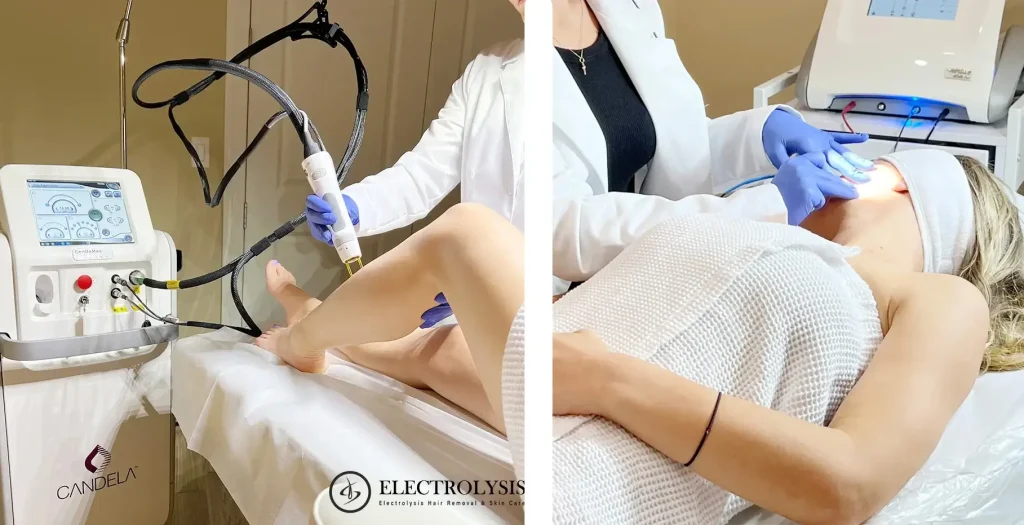
By Valeria Tartacovschi, LE — Founder, Electrolysis 100% Permanent Hair Removal & Skin Care
One of the most common questions we hear from trans clients is whether to choose laser hair removal or electrolysis. For most clients, the honest answer is that it isn’t a choice between the two. The best results usually come from using both, in sequence: laser first, to reduce the bulk of dense, dark hair quickly, and electrolysis afterward, to permanently clear everything laser cannot.
We offer both treatments under one roof, so you can move from one to the other with the same team, without coordinating two clinics or repeating your story to a new provider. What follows is how the approach works, who benefits most, and how we build a plan around it.
Why Two Methods Work Better Than One
Laser and electrolysis are often grouped together, but they work in fundamentally different ways, and each has a limitation the other resolves.
Laser hair removal uses light that targets the pigment in the hair. The follicle absorbs that energy, heats up, and is damaged. Because laser treats a wide area in a single pass, it is efficient, which is a real advantage for a dense, dark beard. Within a few sessions, many clients notice the shadow beneath makeup fading and daily shaving becoming less of a burden, along with a meaningful reduction in the dysphoria that often accompanies facial hair.
Laser has one important limitation, and it is a matter of physics rather than skill: it can only treat hair that contains pigment. Gray, white, blond, and very fine hairs do not absorb the light, so the laser passes over them. This is why the FDA clears laser for permanent hair reduction rather than removal. It thins and lightens hair effectively, but it rarely achieves complete clearance on its own.
Electrolysis is what achieves complete clearance. A fine probe is inserted into each follicle, and a small electrical current destroys the cells responsible for growth, one hair at a time, regardless of color. It is more gradual because it is precise, but it is the only method the FDA recognizes for permanent hair removal, and it treats the gray and light hairs that laser cannot. For a face that needs to stay smooth, or a surgical site that must be fully cleared, that completeness is essential.
Used together, each method addresses the other’s weakness. Laser handles the volume; electrolysis provides permanence and removes the hair laser leaves behind. The result is faster than electrolysis alone and more complete than laser alone.
Who Benefits From this Approach
Most of our trans clients come to us in one of two situations.
Clearing facial hair. For a thick, dark beard, beginning with laser usually makes sense. We reduce the majority of the hair efficiently, then transition to electrolysis for the finer, lighter, and gray hairs that remain. If a beard is already mostly light or gray, or if hormone therapy has left only fine hair, we may begin with electrolysis directly, since laser would have little pigment to target. We determine the right starting point during your consultation.
Preparing for surgery. For clients planning vaginoplasty or other bottom surgery, the surgeon will require the surgical area cleared of hair beforehand and will provide a diagram of the precise area to treat. This is where the combination is especially valuable. Laser can reduce dense, dark hair over several months, and electrolysis completes the clearance, including the gray and white hairs that are common in the genital area and that laser cannot remove. We follow the surgeon’s diagram exactly and coordinate with their office on timing.
A note for clients preparing for surgery: begin early. Published clinical protocols for pre-surgical laser run roughly six to nine months before a surgeon will grant clearance, with sessions every four to six weeks, and electrolysis adds further time on top of that. For readers who want the clinical background, the UCSF Gender Affirming Health Program’s hair removal guidelines offer a clear and reliable overview. The most common difficulty we see is clients who start too late and have to rush the process. If your timeline allows, give yourself a full year.
How We Structure a Plan
Every plan begins with a consultation, because hair color, skin tone, hair density, and your timeline all influence the right approach. There is no single formula that fits everyone.
In general terms, a plan tends to follow this shape:
- We begin with laser, spaced roughly six to eight weeks apart, to treat hairs as they move through their active growth phase. We use the GentleMax Pro Plus, which is safe across skin tones, and every new client receives a complimentary consultation and a test patch first so we can assess how the skin responds.
- As the dark hair thins and what remains is mostly fine, light, or gray, we transition to electrolysis to clear it permanently.
- For surgical preparation, we work to the surgeon’s diagram and deadline, and we will tell you candidly if the timeline is tight.
There is one possibility worth mentioning in advance, so it is never a surprise. A small number of clients, most often on the face and neck, can experience paradoxical hypertrichosis from laser, in which the treatment stimulates some fine hair rather than reducing it. It is uncommon and manageable, and electrolysis treats that hair as well. We monitor for it and adjust the plan if it occurs.
Comfort And Pain Management
Electrolysis has a reputation for being uncomfortable, and we will be honest about that. Each hair receives a small current, and sensitive areas such as the genital region and upper lip are more uncomfortable than others. This is one reason clients sometimes postpone the electrolysis portion of their plan, and it is precisely why we have invested in one of the more comprehensive pain-management programs available at a hair removal clinic.
You should never have to simply endure the discomfort. Depending on the treatment area and your tolerance, we offer:
- Prescription topical numbing cream, applied before treatment to reduce surface sensation. It takes ten to thirty minutes to take effect.
- ProNox nitrous oxide, often called laughing gas. You control the mask and breathe it in as needed; the calming effect begins within seconds and clears as soon as you stop, so you can drive yourself home afterward. Many clients tell us ProNox is what makes a longer session manageable.
- Lidocaine injections, dosed by weight and administered by a board-certified nurse practitioner, which numb the area completely within minutes. This is what makes genital and pre-surgical work genuinely tolerable.
- Oral sedation, taken before treatment, which keeps you awake but deeply relaxed. Some clients are calm enough to rest.
You decide how much support you want. Some clients complete their entire plan with numbing cream alone, while others prefer the full range for longer sessions. Comfort is something you control, not something you have to tolerate. You can review every option and how each works on our pain management page.
Why Complete Both With Us
I founded this clinic in part because there were too few practices doing transgender hair removal well, and fewer still offering the full process under one roof. Sending a client across the city to a separate laser provider and then back to us for electrolysis always seemed like a gap worth closing.
So we closed it. You can begin with laser and move to electrolysis without leaving, with the same team that already knows your history and your goals. We are TG-friendly verified by Laura’s Playground, members of the American Electrology Association and the Electrologists Association of Illinois, and our team speaks English, Romanian, and Russian. Because most of our trans clients travel from out of state, we plan around real timelines and real surgery dates.
If you are at the beginning of this process and unsure where to start, we encourage you to book a consultation. Bring your questions, and your surgeon’s instructions if you have them, and we will map out a plan suited to your hair, your skin, and your timeline. Planning is the part of this work we value most, because once the path is clear, the entire process becomes far less daunting.
You can find us at 1315 N Larrabee St in downtown Chicago, Monday through Friday, by appointment.
Valeria Tartacovschi is a licensed electrologist and the founder of Electrolysis 100% Permanent Hair Removal & Skin Care in Chicago, where she and her team specialize in transgender hair removal.
Have a question about your own hair removal plan? A consultation is the fastest way to a straight answer.